

Table of Contents
- What Is a BAS Statement and Why Does It Matter?
- How to Read Your BAS: The Form Layout at a Glance
- GST Labels Explained
- PAYG Withholding Labels
- PAYG Instalments
- Other BAS Labels You Might See
- The Total Amount Payable or Refundable
- Common BAS Mistakes and How to Avoid Them
- BAS Considerations for Sunshine Coast Businesses
- The Bottom Line
- Still Not Sure About Your BAS?
- Frequently Asked Questions
Key takeaways
- Your BAS may report GST, PAYG withholding, PAYG installments and other business taxes.
- Most small businesses use Simpler BAS and only report G1, 1A and 1B in the GST section.
- Label 1A is the GST collected on sales, while 1B is the GST credits claimed on purchases.
- W1 is gross wages and other withholding payments; W2 is the tax withheld from those payments.
- Accounting software can prepare the figures, but it cannot guarantee that every transaction has been coded correctly.
- Always lodge your BAS on time, even when you cannot pay the full amount by the due date.
Your BAS arrives in your inbox or appears in Xero, and suddenly you are looking at a page full of labels such as G1, 1A, 1B, W1 and W2. It can feel like a code you were never taught to read.
Your BAS statement is one of the most important documents your business lodges with the Australian Taxation Office, but it is not as complicated as it first looks. Once you understand what each section is asking for, the numbers start to make much more sense.
That does not mean you have to prepare and lodge it yourself. It simply means you can understand what your bookkeeper is reporting, ask better questions and sign off with more confidence. Let’s break it down, one label at a time.
What Is a BAS Statement and Why Does It Matter?
A business activity statement, usually called a BAS, is the form Australian businesses use to report GST and certain other tax obligations to the ATO.
Depending on your business, your BAS may include:
- Goods and services tax
- PAYG withholding from employee payments
- PAYG income tax instalments
- Fuel tax credits
- Fringe benefits tax instalments
- Luxury car tax
- Wine equalisation tax
Most businesses must register for GST when their GST turnover reaches or is expected to reach $75,000. The threshold is $150,000 for not-for-profit organisations. Some businesses, including taxi and ride-sourcing operators, have different registration requirements.
You can read more about the ATO’s GST registration requirements.
“Many business owners think BAS simply means GST. In reality, the form can bundle several obligations together.”
Many business owners think BAS simply means GST. In reality, the form can bundle several obligations together. This is why the final amount payable can be significantly higher than the net GST figure alone.
How to Read Your BAS: The Form Layout at a Glance
The exact sections appearing on your BAS depend on what your business is registered to report.
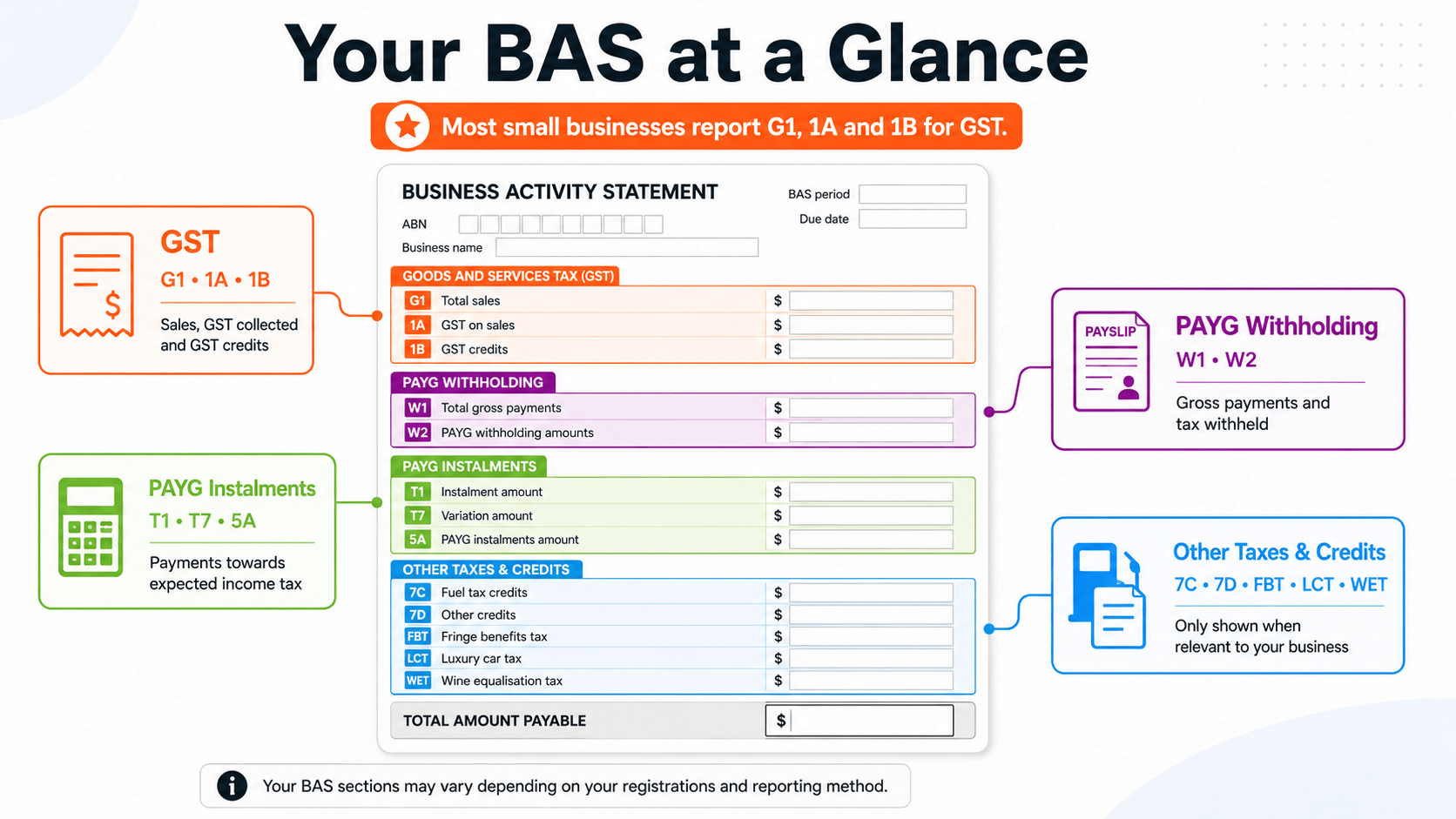
A quick guide to the main sections and labels on an Australian BAS.
| BAS area | Common labels | What it covers |
|---|---|---|
| GST | G1, G2, G3, G10, G11, 1A and 1B | Sales, purchases, GST collected and GST credits |
| PAYG withholding | W1, W2, W3, W4 and W5 | Payments subject to withholding and tax withheld |
| PAYG instalments | T1–T11 and 5A | Prepayments towards expected income tax |
| Fuel tax credits | 7C and 7D | Fuel tax credit claims and adjustments |
| Other taxes | FBT, LCT and WET labels | Industry- or business-specific obligations |
| Summary | Amounts payable and refundable | Your final BAS payment or refund position |
Xero, MYOB and other accounting platforms can pre-populate many of these figures. That certainly reduces manual work, but it does not guarantee accuracy.
If an expense has been coded incorrectly, a personal payment has been treated as a business purchase or a sale has been assigned the wrong GST treatment, the BAS report may still look complete while containing the wrong figures.
Your software can fill the boxes. It cannot decide whether the coding behind those boxes is correct.
This is why reconciliation and review remain so important. KBAS can assist with both the bookkeeping behind the figures and the final BAS lodgement through our Bookkeeping, Payroll and GST services.
Simpler BAS Versus Full BAS
Businesses with a GST turnover below $10 million generally use Simpler BAS. Under Simpler BAS, you report three main GST figures:
- G1: Total sales
- 1A: GST on sales
- 1B: GST on purchases
Businesses using full GST reporting may also need to complete G2, G3, G10 and G11. Do not be concerned if some labels discussed in this guide do not appear on your BAS. The ATO only displays the sections relevant to your registrations and reporting method.
Cash Versus Non-Cash Reporting
Your GST accounting method also affects when transactions appear on the BAS.
Under the cash method, sales and purchases are generally reported when payment is received or made.
Under the non-cash method, sometimes called the accrual method, transactions are generally reported at the earliest of issuing or receiving an invoice and receiving or making payment.
This difference becomes especially important when customers pay late or your business has a large number of unpaid supplier bills at the end of the quarter.
GST Labels Explained
For most businesses, the GST section is the part of the BAS they use most often.
G1: Total Sales
G1 is the total value of your business sales for the reporting period, generally including GST.
It can include:
- Taxable sales
- GST-free sales
- Input-taxed sales
- Export sales
- Other business income that belongs in the GST reporting system
For example, if your business had $49,500 in taxable sales, including $4,500 GST, plus $5,000 in GST-free sales, your G1 figure would generally be $54,500. G1 is not the amount of GST you owe. It is the total sales figure used as the starting point for the GST calculation.
“G1 is not the amount of GST you owe. It is the total sales figure used as the starting point for the GST calculation.”
G2: Export Sales
G2 records export sales that are GST-free. For example, if you sold $8,000 worth of goods to an overseas customer and the sale met the requirements for a GST-free export, you would include the $8,000 at G2.
That amount is also included within G1. G2 simply identifies how much of the total relates to exports.
G3: Other GST-Free Sales
G3 includes GST-free sales other than exports. Depending on the business, this may include certain:
- Basic food products
- Health services
- Education services
- Childcare services
- Eligible going concerns
- Sales of farmland
For example, if a health practitioner provided $12,000 of GST-free services during the quarter, that amount may be reported at G3 as well as being included in G1. GST-free sales are not the same as BAS-excluded transactions. GST-free sales remain part of the GST system, even though no GST is charged.
G10: Capital Purchases
G10 records purchases of capital assets when the business uses full GST reporting. Capital purchases commonly include:
- Vehicles
- Machinery
- Computer equipment
- Major office equipment
- Commercial property
- Significant business assets
For example, if your business purchased a new piece of machinery for $33,000 including GST, the total purchase may appear at G10.
The GST component is not entered at G10. Any available GST credit forms part of the amount reported at 1B.
G11: Non-Capital Purchases
G11 covers day-to-day business purchases rather than major assets. Examples include:
- Rent
- Fuel
- Materials
- Software subscriptions
- Telephone and internet costs
- Professional fees
- Office supplies
- Repairs and maintenance
If your eligible operating purchases totalled $22,000 for the reporting period, the total may be reported at G11 under full reporting. Remember that G11 is the purchase value. It is not the GST credit itself.
1A: GST on Sales
Label 1A is the GST your business has collected, or is required to pay, on taxable sales.
If your taxable sales total $49,500 including GST, the GST component will usually be $4,500. In that example:
1A = $4,500
This is the amount collected from customers and owed to the ATO before your GST credits are deducted. GST-free sales are not included in the calculation of 1A because no GST was charged on those sales.
1B: GST on Purchases
Label 1B is the GST credit your business is claiming on eligible purchases If your business made $13,200 of fully creditable purchases, including $1,200 GST, then:
1B = $1,200
Not every business expense creates a GST credit. For example:
- Wages do not include GST.
- Loan principal repayments do not include GST.
- Some bank fees and financial supplies are input taxed.
- Private purchases cannot be claimed.
- Suppliers not registered for GST cannot charge GST.
- Some purchases may be partly private or partly business.
You also need appropriate supporting records before claiming a GST credit. Our guide to acceptable evidence for claiming a business expense explains what should be retained.
For purchases above $82.50 including GST, you generally need a valid tax invoice before claiming the GST credit.
What About G4, G7 and G9?
This is where many BAS explanations become confusing. Labels G4 to G9 appear on the ATO’s GST calculation worksheet. They do not all appear as separate fields on the BAS you lodge.
On the worksheet:
- G4 identifies input-taxed sales.
- G7 records relevant adjustments.
- G9 shows the worksheet calculation of GST on sales.
The amount calculated through the worksheet is then transferred to 1A.
Input-taxed sales can include residential rent and certain financial supplies. No GST is charged on these sales, and the ability to claim GST credits on related expenses may be restricted.
This area can become complex quickly, particularly for property businesses or organisations making a mixture of taxable, GST-free and input-taxed sales.
How Net GST Is Calculated
For most businesses, the net GST calculation is straightforward:
GST on sales at 1A − GST credits at 1B = Net GST payable or refundable
For example:
- 1A GST collected: $4,500
- 1B GST credits: $1,200
- Net GST payable: $3,300
If 1B is higher than 1A, your GST position may result in a refund.
A refund is not automatically a sign that something is wrong. It may happen when the business has made a large equipment purchase, incurred significant setup costs or had a quieter sales period. Our article on GST credits and refunds explains this in more detail.
PAYG Withholding Labels
If you employ staff or make certain other payments subject to withholding, your BAS may include the PAYG withholding section.
W1: Total Payments Subject to Withholding
W1 is the gross amount of salary, wages and other relevant payments made during the reporting period. It is the amount before tax is deducted.
For example, if employees earned $20,000 in gross wages and $4,200 was withheld in tax:
W1 = $20,000
W1 is not the net amount transferred to your employees’ bank accounts. It also does not include compulsory superannuation contributions.
“W1 is not the net amount transferred to your employees’ bank accounts.”
W2: Amount Withheld from W1 Payments
W2 is the tax withheld from the payments included at W1. Using the same example:
W2 = $4,200
This is the amount the business has withheld on behalf of employees and now needs to pay to the ATO.
Other withholding labels may appear when relevant:
- W3: Other amounts withheld, excluding W2 and W4
- W4: Amounts withheld where a supplier did not quote an ABN
- W5: Total amount withheld
Payroll errors can flow directly into the BAS, which is why payroll records, Single Touch Payroll reporting and the general ledger should agree. Our payroll compliance checklist covers the wider employer obligations that sit behind these figures.
PAYG Instalments
PAYG installments are prepayments towards the expected income tax liability arising from business or investment income. They are different from PAYG withholding:
- PAYG withholding is tax taken from payments made to employees and others.
- PAYG installments are payments towards your own or your company’s expected income tax.
Not every business has this section. The ATO will generally notify you when you enter the PAYG instalment system.
Option 1: ATO-Calculated Instalment Amount
Under this method, the ATO provides a pre-calculated installment amount at T7. That amount is generally transferred to 5A, which is the PAYG income tax instalment payable.
A business may be able to vary the instalment when its expected tax position has changed. When varying, other labels such as T8, T9 and the T4 reason code may apply.
Varying an instalment should not be done simply because cash flow is tight. The variation should be based on a reasonable estimate of the expected tax position.
Option 2: Instalment Rate Method
Under the rate method:
- T1 is your PAYG installment income.
- T2 is the instalment rate supplied by the ATO.
- T3 may be used when varying that rate.
- T4 records the reason for a variation.
- The calculated installment is ultimately reported at 5A.
For example, if your instalment income at T1 is $60,000 and the ATO rate at T2 is 2%, the instalment would generally be:
$60,000 × 2% = $1,200
That $1,200 would form the amount reported at 5A.
The PAYG instalment system is not an extra tax or a penalty. It spreads an expected income tax bill across the year rather than leaving the full amount until the annual tax return is lodged.
“The PAYG instalment system is not an extra tax or a penalty.”
Other BAS Labels You Might See
Most service businesses will not use every section below, but the labels may appear depending on the business’s activities and registrations.
Fuel Tax Credits: 7C and 7D
Fuel tax credits may be available for fuel used in eligible business activities, machinery, heavy vehicles or equipment. This can be particularly relevant to businesses in construction, transport, agriculture, landscaping and some trades.
The labels can seem counter-intuitive:
- 7D is generally the fuel tax credit being claimed.
- 7C is used for an overclaim or decreasing fuel tax credit adjustment.
Eligibility depends on the fuel type, how it is used and the applicable rate. Ordinary fuel used in a light vehicle travelling on public roads will generally not qualify.
Fringe Benefits Tax Instalments
An FBT installment section may appear when the business provides taxable benefits to employees or their associates.
Examples may include private use of a vehicle, certain entertainment, loans or other non-cash benefits.
Luxury Car Tax
Luxury car tax labels are generally relevant to businesses selling or importing vehicles above the applicable threshold.
Most ordinary service businesses will never use this section.
Wine Equalisation Tax
Wine equalisation tax applies mainly to wine producers, wholesalers and certain importers.
Again, the section will usually only appear when the business is registered for the relevant obligation.
The ATO’s business activity statement guidance provides further information about the taxes that may be reported through a BAS.
The Total Amount Payable or Refundable
The final BAS amount combines all applicable obligations and credits.
A simplified example may look like this:
- Net GST payable: $3,300
- PAYG withholding at W2: $4,200
- PAYG instalment at 5A: $1,100
- Fuel tax credit at 7D: $250
Total amount payable: $8,350
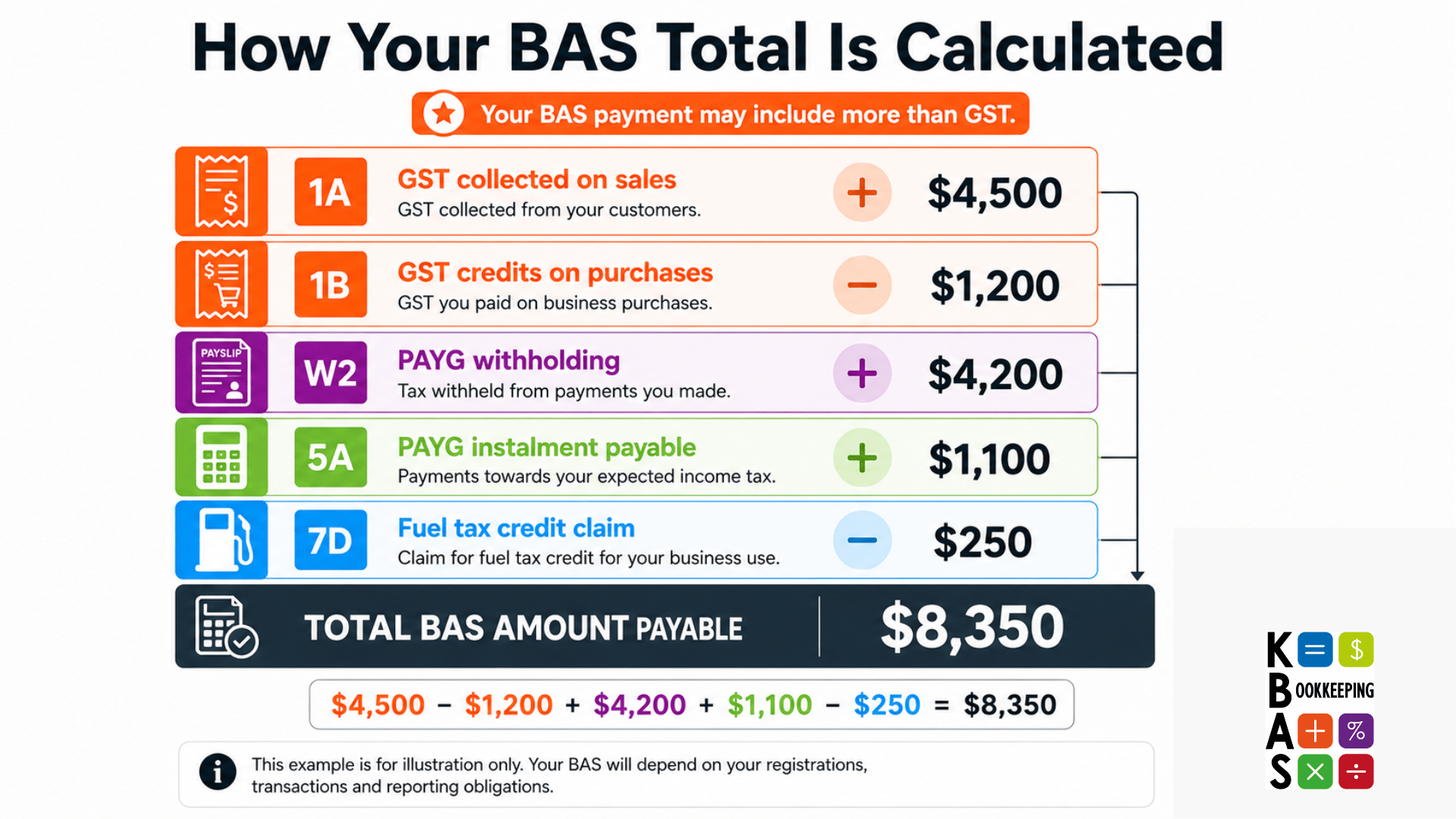
An example of how GST, PAYG withholding, PAYG instalments and fuel tax credits can combine to determine the total BAS payment.
This is why checking only the GST calculation can leave a business owner surprised by the final figure. PAYG withholding and income tax instalments may make up a substantial part of the payment.
“Checking only the GST calculation can leave a business owner surprised by the final figure.”
When the total credits exceed the amounts owed, the BAS may result in a refund. The ATO may first apply the refund against other tax debts. Any remaining refund will generally be paid to the nominated financial institution account after the return has been processed.
What If You Cannot Pay the BAS?
Lodge the BAS by the due date, even when you cannot pay the full amount. Late lodgement and late payment are different issues. Failing to lodge can expose the business to additional penalties, while unpaid balances may attract interest.
The ATO may offer a payment plan or other support when you cannot pay on time.
The sooner the problem is addressed, the more options are usually available.
Common BAS Mistakes and How to Avoid Them
These are easy errors that can catch out otherwise organised business owners.
1. Claiming GST Without the Correct Evidence
Do not assume every receipt or bank transaction supports a GST claim.
2. Treating GST-Free and BAS-Excluded Transactions as the Same
A GST-free sale remains part of the GST system and is included at G1.
A BAS-excluded transaction sits outside the GST calculation. Common examples may include wages, transfers between bank accounts, loan principal repayments and private transactions.
Incorrectly coding these items can distort both sales and purchases.
3. Using the Wrong Accounting Basis
A business reporting GST on a cash basis should not accidentally prepare the BAS using accrual figures, or vice versa.
Confirm the reporting method selected in the accounting software agrees with the business’s ATO registration.
4. Lodging Before Reconciling the Accounts
Before finalising the BAS, reconcile:
- Business bank accounts
- Credit cards
- Sales clearing accounts
- Payment platforms
- Payroll accounts
- GST control accounts
- Uncategorised transactions
A BAS created from unreconciled accounts is unlikely to give you a reliable result.
“A BAS created from unreconciled accounts is unlikely to give you a reliable result.”
5. Entering Net Wages at W1
W1 is the gross amount subject to withholding, not the amount employees received after tax.
Payroll reports should agree with the BAS and Single Touch Payroll records.
6. Assuming Xero Has Made Every Decision Correctly
If your software needs reviewing or your team needs greater confidence using it, our software support and training can help.
7. Missing the Lodgement Deadline
Standard quarterly due dates are generally:
- July to September quarter: 28 October
- October to December quarter: 28 February
- January to March quarter: 28 April
- April to June quarter: 28 July
Different dates may apply when lodging electronically or through a registered BAS agent. Monthly BAS obligations are generally due on the 21st day of the following month.
The ATO also publishes current BAS lodgement and payment due dates.
BAS Considerations for Sunshine Coast Businesses
Sunshine Coast businesses often experience seasonal changes in revenue and expenses.
Tourism, hospitality and accommodation businesses may collect significantly more GST during holiday periods. Trades and construction businesses may have large equipment, vehicle or materials purchases. Health and allied health providers may make a combination of taxable and GST-free sales. These variations can make one quarter look very different from the next.
“These variations can make one quarter look very different from the next.”
This gives you time to:
- Resolve uncoded transactions
- Check unusual GST movements
- Collect missing invoices
- Review payroll liabilities
- Set aside funds for the payment
- Investigate whether fuel tax credits or other claims apply
Whether your business is based in Caloundra, Birtinya, Maroochydore, Buderim, Noosa or elsewhere in Queensland, regular bookkeeping gives you far more control than discovering the BAS result at the last minute.
The Bottom Line
Your BAS is not simply a form that tells you how much to pay the ATO.
It is a summary of important activity within your business: sales, purchases, GST, employee withholding and expected income tax.
Understanding the labels helps you identify unusual figures, plan for the payment and have more useful conversations with your bookkeeper.
But understanding the form and preparing it correctly are two different things. The figures are only as reliable as the bookkeeping, reconciliations and GST decisions behind them.
“The figures are only as reliable as the bookkeeping, reconciliations and GST decisions behind them.”
Still Not Sure About Your BAS?
You should now be able to look at your BAS and understand what the main labels are telling you.
That does not mean you need to spend your time checking every tax code, reconciling every account and worrying about whether something has been missed.
KBAS Bookkeeping is a registered BAS agent supporting Sunshine Coast businesses with bookkeeping, GST, payroll, Xero and BAS lodgement. We look beyond the boxes on the form and review the information behind them, so you have greater clarity and confidence in the figures you are submitting.
“We look beyond the boxes on the form and review the information behind them.”
Contact KBAS Bookkeeping to discuss your BAS, bookkeeping or accounting software setup.
Frequently Asked Questions
Q: What Is the Difference Between a BAS and an IAS?
A: A BAS is generally used by GST-registered businesses and may report GST, PAYG withholding, PAYG installments and other taxes. An instalment activity statement, or IAS, is commonly used when an entity needs to report PAYG withholding or PAYG installments but is not reporting GST for that period.
Q: What Is G1 on a BAS?
A: G1 is the total sales figure for the reporting period. It generally includes taxable, GST-free and input-taxed sales. It is the sales value, not the GST amount.
Q: What Is G11 on a BAS?
A: Under full GST reporting, G11 records non-capital business purchases such as rent, materials, fuel, subscriptions and professional fees. The associated GST credit is included at 1B rather than G11.
Q: What Are W1 and W2 on a BAS?
A: W1 is the gross value of wages and other payments subject to withholding. W2 is the tax withheld from the payments reported at W1.
Q: What Is the Difference Between GST-Free and BAS Excluded?
A: GST-free sales remain part of the GST system but have no GST added. They are generally included in G1 and may also be shown at G2 or G3. BAS-excluded transactions sit outside the GST calculation entirely.
Q: Can I Lodge My Own BAS?
A: Yes. Business owners can prepare and lodge their own BAS. However, only an appropriately registered BAS agent or tax agent can provide BAS services for a fee. Our article comparing a BAS agent with DIY BAS lodgement can help you consider the risks and workload involved.
Q: What Happens If I Lodge My BAS Late?
A: The ATO may apply failure-to-lodge penalties, and unpaid amounts may attract interest. You should lodge on time even if you cannot pay the full amount. Contact the ATO or your adviser promptly to discuss the available options.
Q: How Does Xero Help with BAS?
A: Xero can collect transaction data, apply tax codes and prepare a draft activity statement. However, its output depends on the accuracy of the information entered. Incorrect bank rules, unreconciled accounts and wrongly coded transactions can all produce an incorrect BAS.