


If you have ever felt your stomach drop when you realise the BAS deadline is a week away, you are not alone.
Most Australian small business owners start with good intentions, then the quarter gets busy, invoices pile up, receipts go missing, and suddenly BAS lodgement becomes a late-night scramble.
The stress is only part of it.
A Business Activity Statement is a legal report to the Australian Taxation Office.
When GST, PAYG withholding, or reporting methods are wrong, the cost can show up as penalties, interest, amended BAS forms, and time you cannot get back.
In the worst cases, ongoing BAS errors can increase audit risk and create a bigger clean-up job than anyone expected.

This guide breaks down the BAS agent vs DIY decision in plain English.
You will learn what BAS involves, when DIY BAS is genuinely appropriate, where most people get stuck, and what changes when you hire a registered BAS agent.
One telling statistic:
Businesses using registered BAS agents report 53% fewer ATO inquiries, largely because mistakes are identified early and BAS compliance is handled properly.
Understanding the BAS Basics
A Business Activity Statement is how many Australian businesses report tax obligations to the ATO. Most commonly, it covers GST, PAYG withholding, and sometimes PAYG installments. Lodging BAS is not just “submitting a form”. It is the end result of correct bookkeeping, correct GST treatment, and clean records.
For many small businesses, BAS works like a quarterly check-in with the ATO where you confirm:
-
GST collected and GST paid
If you are registered for GST, you collect GST on sales and pay GST on eligible business purchases. Your BAS is where you report the difference. If you collected more than you paid, you typically pay the balance to the ATO. If you paid more, you may be entitled to a refund. -
GST credits
GST credits are the GST amounts you can claim back on eligible expenses. This sounds straightforward, but it is one of the most common sources of BAS mistakes. It depends on whether GST is actually included, whether the purchase is claimable, and whether you have the right evidence.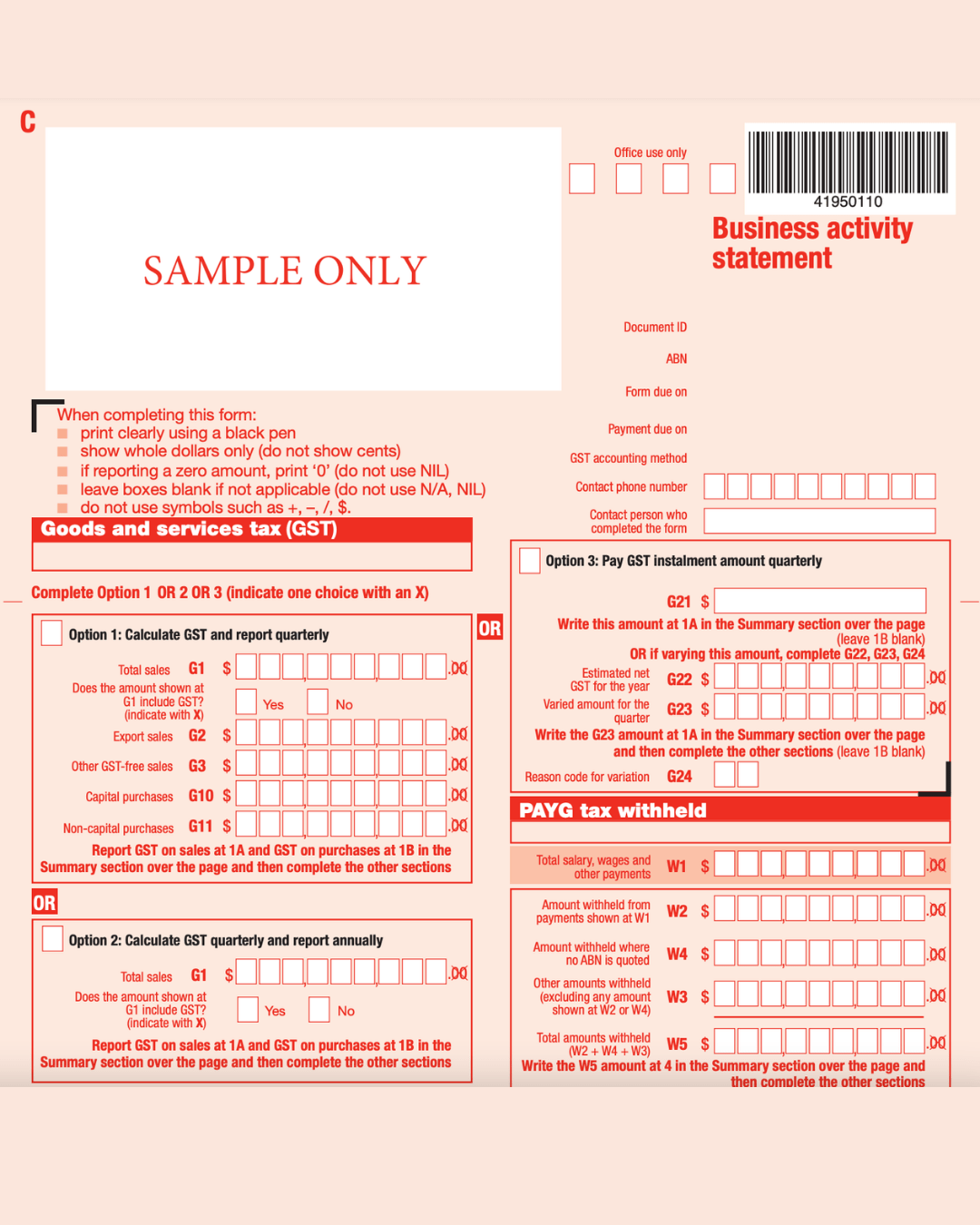
-
PAYG withholding
If you employ staff, PAYG withholding is the tax you withhold from wages and report through your BAS. This requires payroll to be set up correctly and reported consistently. Missing PAYG withholding, or reporting it incorrectly, often triggers follow-up.
Most businesses lodge BAS quarterly, although some lodge monthly or annually. Deadlines matter. If you miss a BAS deadline or lodge BAS incorrectly, BAS penalties and interest can apply, and you may receive queries from the ATO that take time and energy to resolve.
What is a BAS Agent?
A BAS agent is a professional who is registered with the Tax Practitioners Board. This matters because BAS services are regulated in Australia. A registered BAS agent must meet education and experience requirements, follow a professional code of conduct, and stay up to date with compliance changes.
A registered BAS agent can legally:
- Prepare and lodge BAS on your behalf
- Provide advice and support on GST and BAS compliance
- Report and manage PAYG withholding obligations
- Communicate with the ATO for BAS matters
They also hold professional indemnity insurance, which provides an extra layer of protection if a professional mistake occurs.
A bookkeeper may or may not be a registered BAS agent. If you are paying someone for BAS preparation or BAS lodgement, check their TPB registration. It is a simple step that protects your business.

The Case for DIY BAS
DIY BAS can work, but only in the right circumstances. It is usually most appealing early on, when a business is small and every cost feels significant. Some owners also like being close to the numbers, and there is real value in understanding how money moves through your business.
Pros of DIY BAS
-
You may save on professional fees
If your quarterly BAS is genuinely simple, you might avoid paying for BAS services, at least for a period of time. For a tight budget, that can feel like the practical choice. - You stay connected to your finances
When you do BAS preparation yourself, you are forced to review income, expenses, and cash flow. Many business owners notice patterns sooner when they are hands-on, such as rising costs or delayed customer payments. - It can build confidence and understanding
Some owners feel more in control when they know how GST and BAS compliance works. If you are the kind of person who learns quickly and enjoys systems, DIY may feel manageable. - It can suit very simple businesses
A sole trader with minimal transactions, straightforward GST, no payroll, and reliable record keeping may be able to lodge BAS without major issues.
When DIY Makes Sense
DIY BAS is most realistic when your business is simple and you have the knowledge and time to do it properly. If you are a sole trader with low transaction volume, clear income sources, and few expense types, DIY might be workable. It also helps if you are using accounting software correctly, reconciling regularly, and you understand the GST rules behind the numbers.
The key is being honest. DIY BAS is not “free”. You are paying with your time, your attention, and your risk.
The Hidden Costs of DIY BAS
This is where the BAS agent vs DIY decision often changes. Many business owners can handle the basics, but the hidden costs appear when the bookkeeping is not clean, the GST rules are misunderstood, or the workload becomes heavier as the business grows.
Common DIY BAS Mistakes
-
Claiming GST on ineligible expenses
Not every bill includes GST, and not every purchase is GST claimable. Expenses such as water, rates, and certain food items often create confusion. If GST is claimed where it should not be, the BAS may need to be amended later.
-
Confusing cash vs accrual reporting
GST can be reported using cash or accrual accounting methods, depending on your business setup. Cash reporting generally follows when money is received or paid. Accrual reporting follows invoices and bills. Mixing these up can distort figures and create compliance issues.
-
Not reconciling bank accounts
Unreconciled accounts are a major cause of incorrect BAS lodgement. If bank accounts are not reconciled, your accounting software may not reflect reality, even if it looks “complete”. This is often linked to disputes and ATO questions.
-
Incorrect coding in accounting software
Accounting software is only as accurate as the information entered. If transactions are coded to the wrong account, assigned the wrong GST treatment, or posted incorrectly, your BAS preparation will be wrong, even if it appears tidy.
-
Forgetting PAYG withholding reporting
Once you have employees, compliance complexity increases. PAYG withholding must be reported correctly, and mistakes can lead to ATO follow-up, payroll corrections, and time-consuming fixes.
-
Missing GST credits on imports
Imports are a common area where businesses lose money. If import GST credits are not captured correctly, you can miss out on significant amounts over time. It is not unusual for businesses to lose thousands in GST credits simply because the paperwork and coding were not handled properly.
-
Over-relying on software suggestions
Software can suggest categories and GST codes, but it will not question whether something is valid. It can only work with the information you feed it. If the input is wrong, the BAS output will be wrong too.
Financial Consequences
DIY BAS mistakes can lead to real costs quickly:
- BAS penalties are calculated in penalty units, with each unit $313 (as of July 2024).
- Interest on underpaid tax can be 9% or more.
- Fixing errors takes time, and time is usually the most expensive cost for a business owner.
- Ongoing issues can increase audit risk, which brings more stress and professional costs.
Many owners who started with DIY BAS do not switch because they dislike it. They switch because the cost of getting it wrong becomes too high.
The Benefits of Hiring a BAS Agent
A registered BAS agent is not just there to “submit the BAS”. The value is in having an expert check the details, keep compliance consistent, and remove unnecessary pressure from your quarter.
-
Extended Lodgement Deadlines
One major practical advantage is the extended lodgement deadline. If you lodge BAS yourself, your BAS deadline is typically 28 days after quarter end. With a registered BAS agent, you often gain access to an extended lodgement deadline of around 8 weeks.
That extra time can improve cash flow flexibility and reduce rushed decisions. -
Expertise and Accuracy
A professional BAS agent has specialised GST knowledge and knows where problems hide. They look for incorrect GST claims, coding issues, missing information, and inconsistencies that could trigger ATO queries. They also identify missed GST credits, which can put money back in your business. -
Fewer Year-End Tax Adjustments
When BAS lodgement is done properly each quarter, your records stay cleaner through the year. This reduces the messy adjustments that often appear at tax time and makes it easier for your tax agent to finalise your return. -
ATO Representation
A BAS agent can legally communicate with the ATO on your behalf for BAS matters. If the Australian Taxation Office asks questions, a professional can respond correctly, provide the right information, and manage the process without panic. -
Safe Harbour Protection
Using a registered BAS agent can reduce your liability for certain administrative penalties where safe harbour rules apply. Add to that professional indemnity insurance, and you have more protection if an error occurs due to professional work.
When to Hire a BAS Agent
You do not need to wait until something goes wrong. The best time to hire a BAS agent is when you can see the workload or risk increasing, even if you are still coping.
Clear Signs You Need Professional Help
If any of the following are true, it is worth considering a professional BAS agent:
- Your business is growing, and transactions are increasing.
- You have multiple revenue streams, such as products plus services.
- You import goods or deal with complex financing arrangements.
- You employ staff and manage PAYG withholding.
- You have received ATO queries or had to amend BAS before.
- You are spending too much time on BAS preparation and compliance.
- You want access to the extended lodgement deadline.
- You are not confident your BAS is correct.
The Decision Matrix
Here is a simple way to decide:
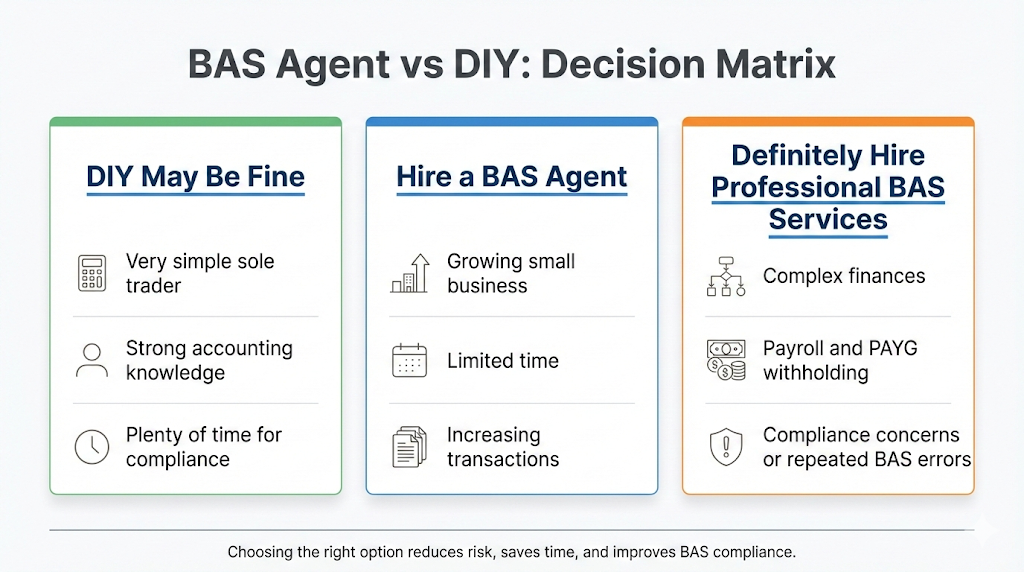
- Very simple sole trader, strong accounting knowledge, plenty of time: DIY may be fine
- Growing small business, limited time, increasing transactions: hire a BAS agent
- Complex finances, payroll, compliance concerns, or repeated BAS errors: definitely hire professional BAS services.
How to Choose the Right BAS Agent
Choosing the right BAS agent is as important as choosing to use one. You want someone who is proactive, clear, and consistent.
Here is what to check before you commit:
-
TPB registration
Confirm they are registered with the Tax Practitioners Board. If they are not TPB registered, they should not be providing BAS services for a fee.
-
Industry experience
Ask whether they work with businesses like yours. Industry knowledge helps with correct GST treatment and practical advice.
-
Software compatibility
A good BAS agent should work confidently with your accounting software. This makes BAS preparation smoother and reduces the time spent fixing avoidable issues.
-
Fee structure
Make sure you understand what is included, what is extra, and how pricing changes if the books are not up to date.
-
Professional indemnity insurance
This is a must. It protects you and signals professional standards.
-
References
If you want extra reassurance, ask for references or reviews. A good agent will have happy clients who value accuracy and reliability.

Conclusion
DIY BAS can work when a business is genuinely simple. If you are a sole trader with minimal transactions, strong accounting knowledge, and the time to reconcile regularly, doing your own BAS lodgement may be a reasonable option.
For most growing small businesses, however, the smarter long-term choice is a registered BAS agent. The benefits add up quickly: fewer BAS errors, better GST treatment, fewer year-end adjustments, support if the ATO asks questions, and access to an extended lodgement deadline that reduces pressure.
The real question is not “Can I do this myself?” It is “What is my time worth, and what will it cost if I get it wrong?” BAS penalties, interest, missed GST credits, and hours spent correcting problems often exceed professional fees.
If you are unsure, use the decision matrix above to assess your situation honestly. If you want support, KBAS can review your setup and help you choose the most cost-effective path forward.
Call us on 07 5408 7400 or contact us on our website to chat about it today.