

What Employers Need to Review Before Payday Super Starts
Payroll is not something to tidy up every year after 30th of June. By then, most of the numbers have already flowed through payroll, super, STP, PAYG withholding and employee income statements.
This year, there is another reason to check everything early.
From 1 July 2026, Payday Super starts. Employers will need to pay super at the same time they pay salary and wages, with contributions generally needing to reach the employee’s super fund within 7 business days of payday.
That is a big timing change for businesses that currently pay super quarterly.
EOFY is also the time to prepare your Single Touch Payroll finalisation. For most employers, STP finalisation for the 2025–26 financial year is due by 14 July 2026.
So before the financial year closes, it is worth checking your payroll, super setup and cash flow.
What is changing with super from 1 July 2026?
Payday Super changes when employers pay super. At the moment, many businesses pay super quarterly. For the April to June 2026 quarter, super is still due by 28 July 2026.
From 1 July 2026, employers will need to pay super on payday. That means if you pay staff weekly, fortnightly or monthly, super will need to be handled much closer to that same pay cycle.
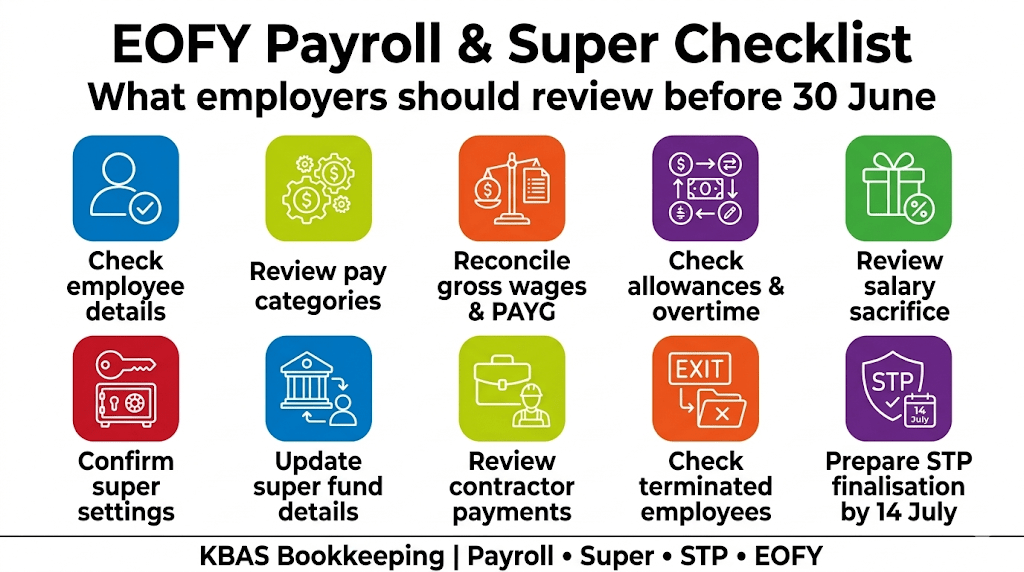
The wording is also changing. Super guarantee will be calculated on qualifying earnings. This is the new term used for the earnings base that applies under Payday Super.
There should not be any changes as the way super is calculated. Only the name and timing are changing. If you have been using the quarter to manage cash flow, this will need to change.
Why payroll needs to be reviewed before EOFY
Payroll problems usually start small. A pay category is set up incorrectly. An allowance is treated the wrong way. A terminated employee is missed. A super fund detail is out of date.
One small issue can flow into STP, PAYG withholding, super, leave balances and employee income statements.
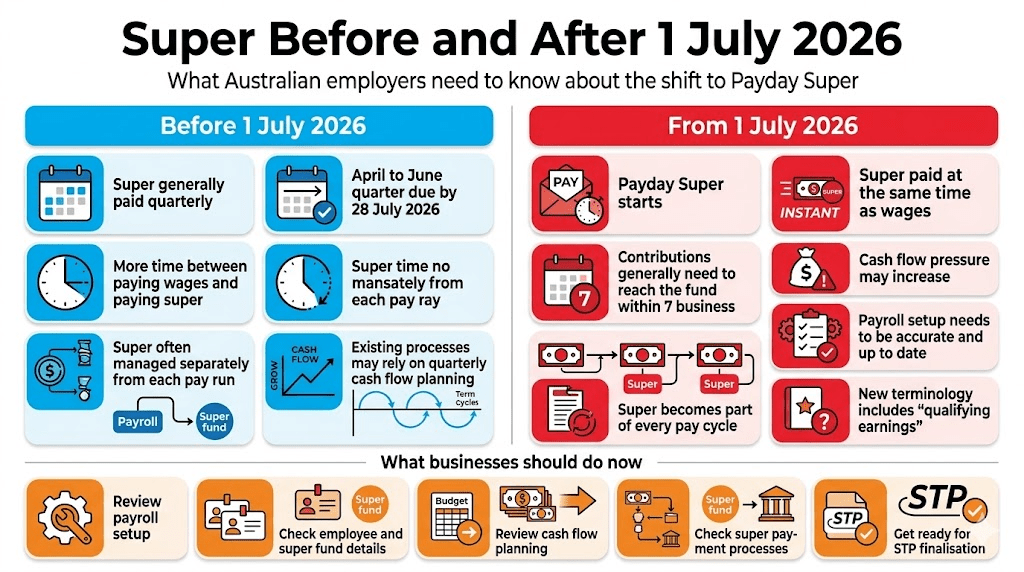
Before EOFY, check:
- Employee names and tax file numbers
- Addresses and dates of birth
- Employment status
- Termination dates
- Gross wages
- PAYG withholding
- Allowances
- Bonuses and commissions
- Overtime
- Leave loading
- Salary sacrifice
- Super guarantee
- Contractor payments that may need super reviewed
If the data is wrong before finalisation, fix it before you lodge.
What about employee summaries?
Many business owners still call them employee summaries or payment summaries. For most employers now, this is handled through STP finalisation.
Once employee information has been reported and finalised through STP, employers generally do not need to provide separate payment summaries for that same information.
Employees access their finalised income statement through myGov. This is why the 14 July deadline matters. Employees need accurate income information so they can complete their tax returns.
Check your super payment process
This is the year to check how super is actually being paid. Do not just check the amount. Check the process.
Look at:
- Which clearing house you use
- Whether employee super details are current
- Whether any payments have bounced back
- Whether your payroll software is calculating super correctly
- How long payments usually take to reach the fund
- Who approves the super payment
- What happens when someone is away
If you use the ATO Small Business Superannuation Clearing House, you need to move to another option. Existing users can continue using it until 11:59 pm AEST on 30 June 2026, then access ends.
Leaving this until the last week of June is not ideal.
Cash flow is the real issue
The biggest change for many small businesses will not be the calculation. It will be the timing.
Quarterly super gives a business time between paying wages and paying super. Payday Super removes most of that gap. That means super needs to be planned as part of each pay run, not as a separate quarterly bill.
Before 1 July, work out:
- Your average super cost per pay cycle
- Whether you have enough funds available on payday
- Whether wages, super, BAS and supplier payments clash
- Whether your payroll approval process is too slow
- Whether you need a separate super holding account
- Whether your cash flow forecast needs updating
This is especially important for businesses with seasonal income, casual staff, changing rosters or tight margins.
Common payroll and super mistakes to avoid
Finalising STP before all pay runs are complete
Make sure June wages, bonuses, leave payouts and termination payments are processed before finalisation.
Forgetting terminated employees
If an employee was paid during the financial year and reported through STP, they still need to be included.
Assuming the software is right
Payroll software follows the settings behind it. If the pay categories are wrong, the reports will be wrong.
Treating super as a quarterly task after 1 July
From 1 July 2026, super becomes part of each pay cycle.
Ignoring bounced or rejected super payments
Under Payday Super, delays will matter more. Check rejected payments quickly and fix the cause.
Not planning for cash flow
If super has always been paid quarterly, the new timing may affect how much cash is available after each pay run.
Local insight for Sunshine Coast business owners
Many Sunshine Coast businesses operate with seasonal income, casual teams, changing rosters and tight cash flow. Hospitality, trades, retail, health, construction, tourism and professional services businesses can all feel the impact of payroll timing changes.
That is why this is not just an EOFY compliance job. It is a business planning job.
If your income changes from month to month, or your wages increase during busy periods, you need to know how Payday Super will affect your cash position before the new rules start.
A clean payroll file gives you better visibility. Better visibility makes it easier to plan.
The Bottom Line
Payroll and super need attention before EOFY, not after it. With Payday Super starting on 1 July 2026 and STP finalisation due by 14 July, now is the time to check your payroll setup, employee records, super details and cash flow.
A clean payroll file makes EOFY easier. It also puts your business in a better position for the new super rules.
If you need help reviewing your payroll, STP or super setup before EOFY, KBAS Bookkeeping can help you get organised before the deadlines arrive. Get in touch today so we can help you move into the new financial year with confidence.
FAQs
When does Payday Super start?
Payday Super starts on 1 July 2026. From that date, employers will need to pay super on payday, with contributions generally needing to reach the employee’s super fund within 7 business days.
Is super still quarterly before 1 July 2026?
Yes. For the April to June 2026 quarter, super is due by 28 July 2026. That is the final quarter before Payday Super starts.
What is qualifying earnings?
Qualifying earnings is the new term used under Payday Super to work out super guarantee. It includes ordinary time earnings and other payments that count for super purposes.
When is STP finalisation due?
For most employers, STP finalisation is due by 14 July each year. For the 2025–26 financial year, that means 14 July 2026.
Do I still need to give payment summaries?
Generally, no. If the employee information has been reported and finalised through STP, employees access their finalised income statement through myGov.
What should I check before finalising payroll?
Check employee details, gross wages, PAYG withholding, allowances, deductions, super, salary sacrifice, termination payments and year-to-date balances in your payroll software. If the reports do not match, fix the issue before finalising.
Should I pay June quarter super before 30 June?
This depends on your business cash flow and tax position. The due date for the April to June quarter is 28 July 2026, but some businesses choose to pay earlier. Speak with your bookkeeper or accountant before deciding what is best for your business.
What happens if my business uses the ATO Small Business Superannuation Clearing House?
You will need to move to another option. Existing users can continue using the ATO Small Business Superannuation Clearing House until 11:59 pm AEST on 30 June 2026. After that, the service will no longer be available.