


Have you ever looked at your numbers and thought, “Do I need a bookkeeper, an accountant, or both?”… and then just scratched your head?
A lot of business owners use the terms interchangeably, but they are not quite the same thing, and knowing the difference can save you time, money, and a fair bit of stress.
In simple terms, a bookkeeper usually keeps your day-to-day financial records accurate and up to date, while an accountant usually steps in at a higher level for year-end reporting, tax, and broader financial advice.
In Australia, the exact services someone can legally provide for a fee can also depend on whether they are registered as a BAS agent or tax agent.
What is a bookkeeper and why do you need one?
A bookkeeper is usually the person who helps keep the financial engine room of the business running.
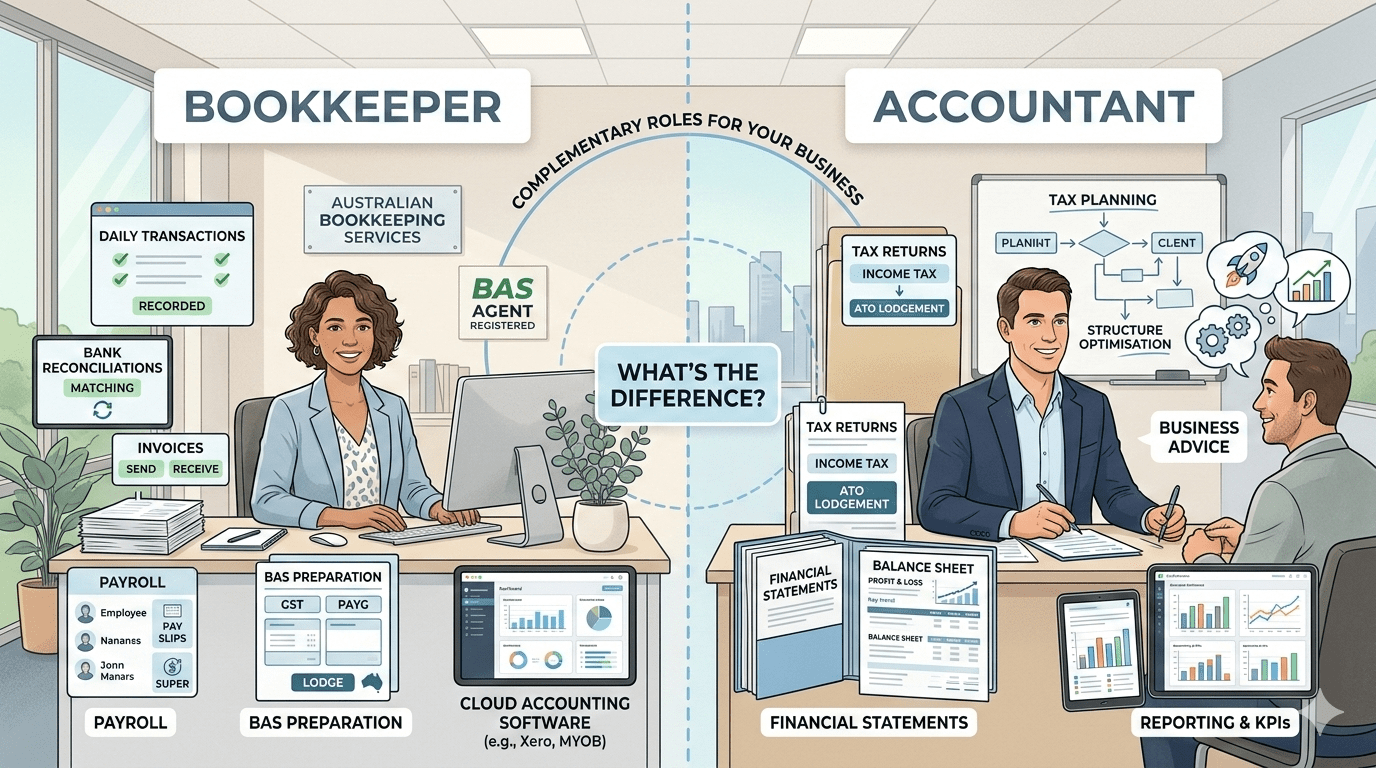
A bookkeeper manages the day-to-day financial records of your business, including transaction recording, bank reconciliations, invoicing, and payroll processing. They also play an important role in providing practical, operational insights to help you understand how your business is performing on a regular basis.
When choosing a bookkeeper, it’s important to work with a registered BAS Agent. This means they are registered with the Tax Practitioners Board (TPB), are compliant with current regulations, and are qualified to provide BAS and GST services. A registered BAS Agent is also required to hold appropriate insurance, giving you added protection and confidence that your financial records are handled correctly.
Good record keeping is not just admin. The ATO expects businesses to keep records that explain their transactions and support their tax, super, and employer obligations.
This matters because your reports are only useful if the data going into them is right. If the coding is wrong, the payroll is messy, or the reconciliations are behind, you can end up making decisions on bad information. That usually creates problems later at BAS time, tax time, or both.
Key benefits of having a bookkeeper
- Your records stay current and organised.
- BAS and payroll information are easier to prepare correctly.
- You get clearer visibility over cash flow, debtors, and expenses.
- Your accountant spends less time cleaning up the file at year end.
- You reduce the risk of missing records, errors, and avoidable rework.
What is an accountant and why do you need one?
An accountant focuses on higher-level financial oversight and compliance. They provide advice on business structure, tax planning, superannuation, and overall financial strategy. Their role is to help ensure your business is set up correctly from a tax and legal perspective, while also supporting long-term financial decisions.
Public accounting services in Australia commonly include financial reporting, taxation, management accounting, management consulting, and other advisory services.
Where this becomes important for business owners is tax and formal advice.
Under Australian rules, tax agent services can only be provided for a fee by someone registered with the Tax Practitioners Board.
Those services include preparing or lodging returns and giving advice about taxation law that a client can reasonably be expected to rely on.
Key benefits of having an accountant
- Year-end financial statements and tax work are handled properly.
- You get help interpreting profit, expenses, and business performance.
- You can get advice on tax obligations and compliance from a registered practitioner.
- Larger decisions, such as structure, growth, and reporting, are easier to assess with the right financial input.
Bookkeeper vs accountant: the practical difference
The easiest way to think about it is this:
A bookkeeper is usually focused on keeping the day-to-day numbers accurate and current.
An accountant is usually focused on interpreting those numbers, preparing formal reports, and handling tax and year-end obligations where appropriately registered.
There is also some overlap. For example, many bookkeepers handle BAS-related work, but if they are providing BAS services for a fee, they generally need to be registered as a BAS agent or work under the supervision and control of a registered BAS or tax agent.
BAS services include things like preparing or lodging approved forms under BAS provisions, advising on GST, PAYG withholding, and certain payroll reporting matters where a client relies on that advice.
Likewise, an accountant may also provide bookkeeping services, but if they are charging for tax agent services, they need the right Tax Practitioners Board (TPB) registration for that work.
How to choose the right support for your business in 4 steps
1. Start with the work that needs doing every week or month
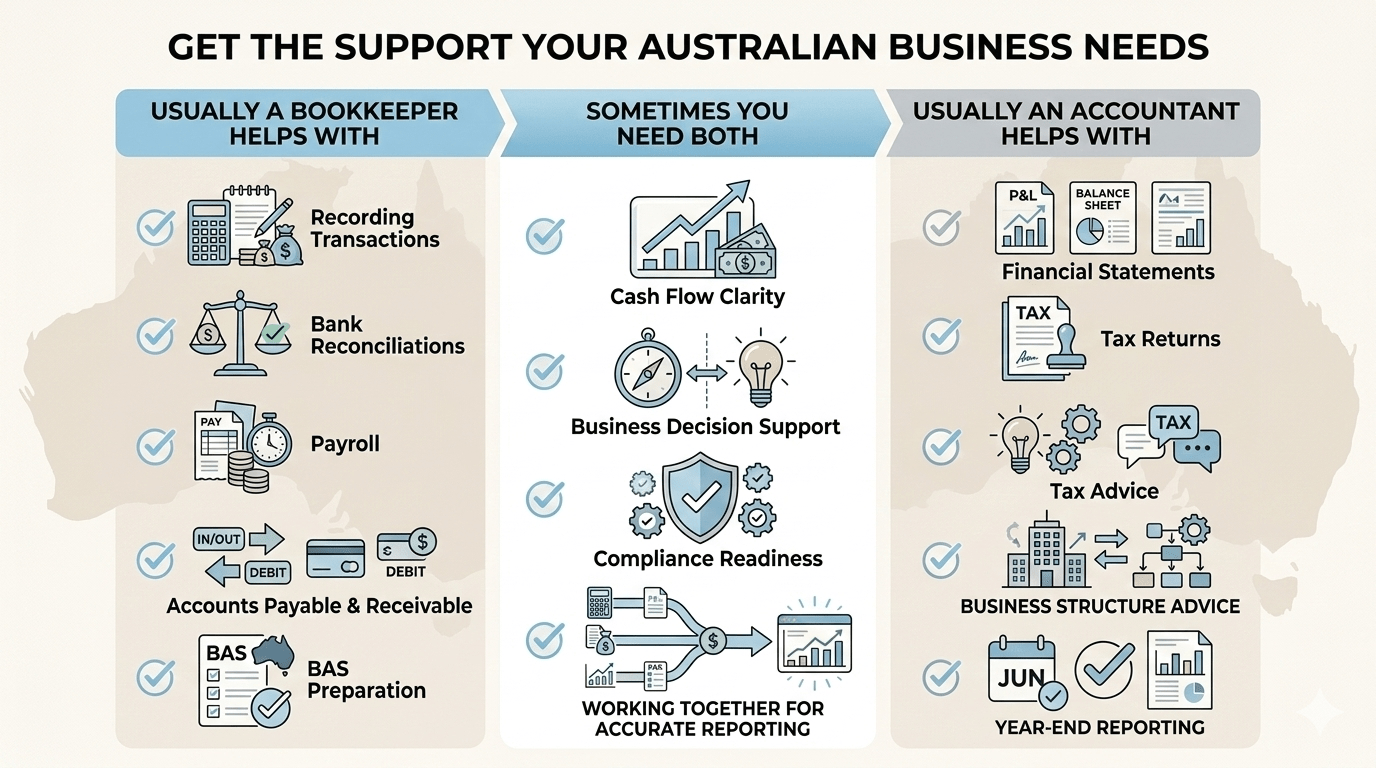
If your main issue is keeping Xero up to date, reconciling transactions, staying on top of invoices, payroll processing, or getting ready for BAS, a bookkeeper is often the first place to start. Accurate records are the foundation for everything else.
2. Look at the level of advice you need
If you need income tax returns prepared, tax advice, year-end financial statements, or help understanding the bigger picture from a tax and reporting perspective, you may need an accountant or registered tax agent.
3. Check registration, not just the job title
This is the part many businesses miss. In Australia, the legal question is not just whether someone calls themselves a bookkeeper or accountant. It is whether they are registered to provide the service they are charging you for. BAS services and tax agent services are regulated by the TPB.
4. Understand that many businesses need both
In real life, the best setup is often not a bookkeeper or an accountant. It is having a bookkeeper and an accountant.
A bookkeeper keeps the file clean during the year. An accountant uses that information for tax, reporting, and higher-level advice. When those two roles work well together, the business owner usually gets faster answers, cleaner compliance, and fewer nasty surprises. This also reduces duplication, because the accountant is not spending unnecessary time fixing basic coding and record-keeping issues before they can do the important work.
Common mistakes business owners make
Thinking bookkeeping is just data entry
It is not. Clean books affect BAS accuracy, payroll reporting, cash flow visibility, and how reliable your reports are.
Asking tax questions to someone who is not registered to answer them for a fee
Not every financial professional can legally provide the same services. In Australia, registration matters.
Waiting until year end to fix everything
The longer problems sit in the file, the harder and more expensive they usually are to clean up. Accurate records throughout the year make tax and reporting much easier.
The Bottom Line
A bookkeeper and an accountant are not competing options. They solve different problems.
For many businesses, the strongest setup is both: accurate records during the year, and the right tax and reporting support when it counts.
If your books are behind, your reports do not make sense, or you are not sure where bookkeeping ends and accounting begins, we can help you get the foundations right and work alongside your accountant so nothing falls through the cracks. Get in touch today.