


Table of Contents
- What Is Accounts Receivable and Why Does It Matter
- Set Up Your Invoices for Faster Payment
- Build a Credit Policy Before You Extend Credit
- Create a Collections Process and Follow It
- Use Your Accounting Software to Manage Receivables
- Make Payment Easier for Customers
- Track a Few Useful Accounts Receivable Measures
- Connect Receivables to BAS and Local Cash Flow
- Get on Top of Accounts Receivable
- Frequently Asked Questions
Key takeaways
- Agree payment terms before starting work and show an actual due date on every invoice.
- Follow a consistent reminder schedule, with someone responsible for the next action.
- Review your aged receivables weekly using reconciled records.
- Use automation for routine reminders and personal contact to resolve problems.
- Check your GST accounting method when planning for BAS payments.
You’ve finished the work, sent the invoice and watched the due date pass. Meanwhile, wages, suppliers and your own bills still need paying. Managing accounts receivable gives you a clearer way to collect what you’re owed before late payments put pressure on the rest of your business.
The process starts before you send an invoice. Your payment terms, customer checks and follow-up routine all affect how quickly money reaches your bank account.
Here’s a practical approach for Australian small businesses, including how to use Xero, when to follow up personally and what overdue invoices can mean at BAS time.
What Is Accounts Receivable and Why Does It Matter
Accounts receivable is money customers owe your business for goods or services you’ve already supplied on credit. Each unpaid invoice remains in your accounts receivable ledger until it is paid, credited or otherwise correctly dealt with.
For example, imagine a Sunshine Coast plumber invoices $8,000 during May and has collected $3,500 against those invoices by early June. The remaining $4,500 is accounts receivable. Some may still be within the agreed payment terms; some may be overdue.
That distinction matters. An outstanding invoice isn’t automatically a problem, but you need to know when it should become cash.
“An outstanding invoice isn’t automatically a problem, but you need to know when it should become cash.”
A business can show a profit while struggling to pay its bills because sales have been recorded before customers have paid. Better accounts receivable management helps you plan supplier payments, reduce time spent chasing debtors and spot payment problems earlier.
Set Up Your Invoices for Faster Payment
Send invoices promptly once the agreed billing point is reached. Waiting until Friday to invoice Monday’s completed job adds several days before the customer’s payment period even starts.
Make each invoice easy to check and pay. Include:
- Your business name, ABN and contact details.
- The customer’s correct details and any required purchase order number.
- A unique invoice number and issue date.
- A clear description of the work, with quantities and prices where relevant.
- The total payable and correct GST information.
- A specific due date and clear payment instructions.
For GST-registered businesses making taxable sales, the invoice must meet the tax invoice requirements. Clearly label the document “Tax invoice”. Requirements include showing the GST payable, or an appropriate GST-inclusive statement, and identifying taxable items. Tax invoices for sales of $1,000 or more also need the buyer’s identity or ABN.
Send the invoice to the person who processes payments. Xero’s invoice status information can help you see whether an online invoice has been viewed, but that doesn’t confirm approval for payment.
Choose Terms That Fit Your Cash Flow
Seven, 14 and 30 days are possible payment terms. For a service business paying costs upfront, 14 days is a sensible starting point to discuss with customers. Thirty days may suit an established commercial relationship, provided your cash flow can carry the wait.
Consider Upfront Deposits and Cash on Delivery
Not every customer needs to be offered extended payment terms. Requesting an upfront deposit can help protect cash flow, particularly for larger projects, new customers or jobs that require significant materials or preparation costs. Deposits can reduce the financial risk of carrying expenses before receiving payment.
Cash on Delivery (COD) terms are another option worth considering. Under this arrangement, payment is required when goods are delivered or services are completed, rather than allowing customers to pay weeks later. Both approaches can help businesses minimise outstanding receivables, reduce payment delays and maintain more predictable cash flow.
Whichever approach you choose, make sure payment terms are clearly communicated and agreed upon before work begins, and comply with any applicable industry requirements.
Agree to the terms in your quote or contract. Writing a shorter deadline on the invoice doesn’t override an existing agreement. The Australian Government’s payment terms guidance explains how credit and collection arrangements fit into your sales contract.
“Writing a shorter deadline on the invoice doesn’t override an existing agreement.”
Check Whether an Early Payment Discount Is Worth It
“2/10 net 30” means a customer receives a 2% discount for paying within 10 days; otherwise, the full amount is due within 30 days.
On a $5,000 invoice, you give up $100 to bring payment forward by up to 20 days. Compare that cost with your margin and the cost of waiting. It may help during a tight period, but offering it routinely to customers who already pay promptly reduces your return unnecessarily.
Build a Credit Policy Before You Extend Credit
A credit policy sets out who can pay later, how much they can owe and what happens if payments fall behind.
Record your standard terms, credit limits, who approves exceptions and when further credit will be reviewed. Have customers accept the relevant terms before you supply the work.
Check New Customers Before Offering Credit
Confirm the legal entity you’re dealing with, rather than relying only on a trading name. Use ABN Lookup and ASIC’s company information, check the billing address and ask for trade references where appropriate. Basic registration checks establish identity; they don’t establish that a customer can afford to pay you.
“Basic registration checks establish identity; they don’t establish that a customer can afford to pay you.”
For larger exposure, consider a commercial credit report. For a first project, a lawful deposit or staged payments may reduce the amount you’re carrying.
If you supply a large business, check its published payment performance through the Payment Times Reporting Scheme. The scheme covers qualifying large businesses and publishes information about payments to small suppliers. Historical performance can inform your planning, although it doesn’t guarantee when your invoice will be paid.
Create a Collections Process and Follow It
Choose one person to own follow-up and give them time each week to do it. Before contacting anyone, reconcile incoming payments and check for credit notes, billing errors or an agreed payment arrangement.
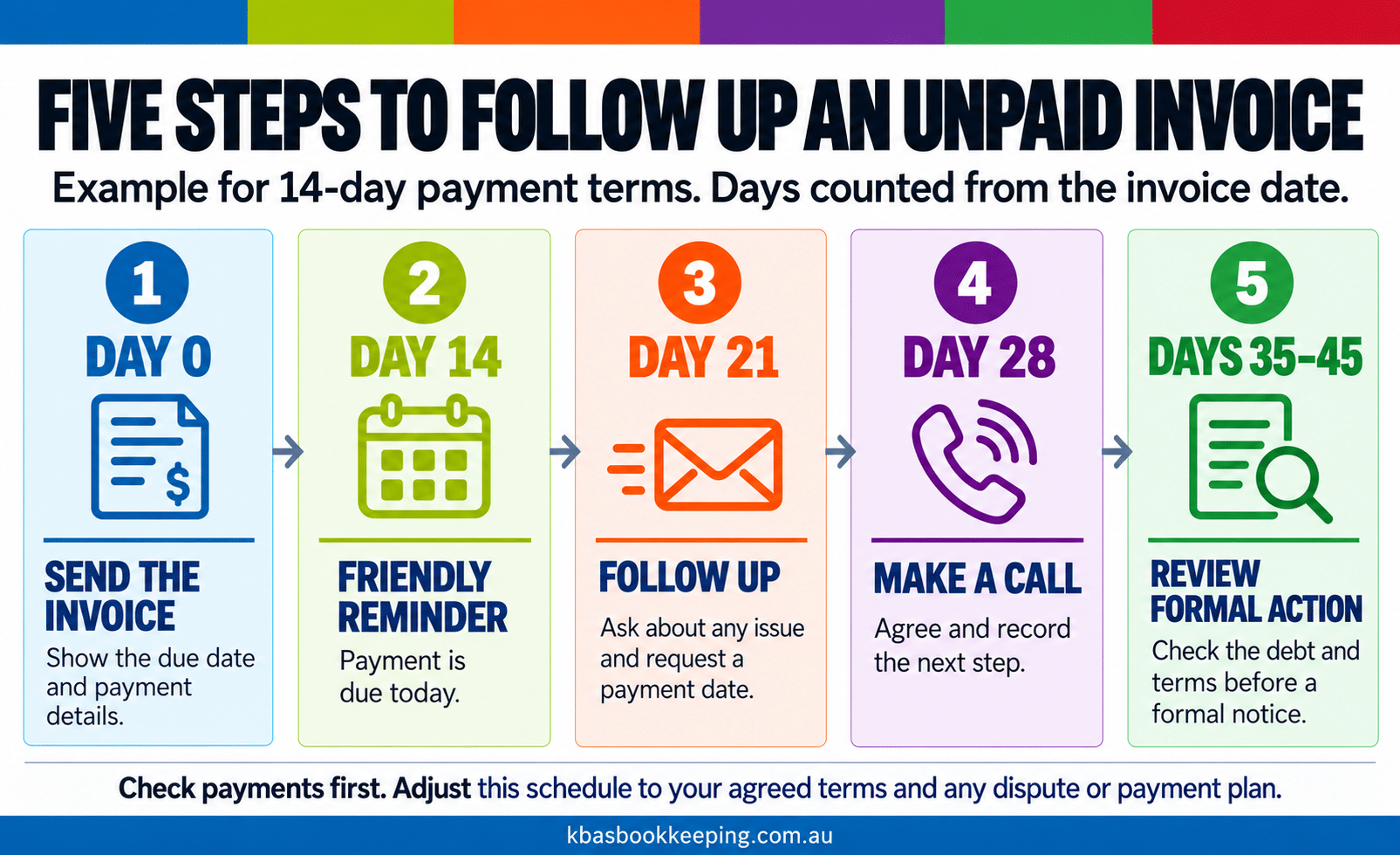
A Five Step Payment Follow Up Sequence
This example uses 14-day payment terms. Days run from the invoice date. Adjust the schedule to match your actual agreement.
| When | Action | What to include |
|---|---|---|
| Day 0 | Send the invoice | Due date, clear description and payment details. Confirm the billing contact. |
| Day 14 | Send a friendly due-date reminder | Invoice number, amount and payment link. Say it is due today, rather than already overdue. |
| Day 21 | Send a second reminder | Confirm the overdue balance, ask about any problem and request a payment date. |
| Day 28 | Make a phone call | Establish what is holding payment up and agree a specific next step. |
| Days 35–45 | Review for formal action | If unresolved, send an appropriate formal notice or letter of demand after checking the facts and terms. |
Record promised payment dates and follow up if they’re missed. If a customer disputes the work, investigate the dispute instead of sending increasingly firm automated emails. Where a payment plan is appropriate, confirm the instalments and dates in writing and monitor them.
“If a customer disputes the work, investigate the dispute instead of sending increasingly firm automated emails.”
When to Send a Letter of Demand
A letter of demand may be appropriate after ordinary reminders and attempts to resolve the issue haven’t worked. It should identify the parties, explain the debt, state the correct outstanding amount and give a clear payment deadline. Attach relevant documents and describe the action you are prepared and entitled to take.
The Government’s letter of demand guide and template provides a useful starting point. Seek legal advice if the debt is disputed or the contractual position is unclear.
When to Consider Debt Collection or QCAT
An invoice still unpaid 60–90 days after its due date deserves a deliberate recovery decision, although you may need to act sooner. Compare the amount owed with recovery costs, the evidence available and the customer’s ability to pay. Obtain a fee quote before engaging a collector.
In Queensland, QCAT’s minor debt process can cover eligible claims for an agreed, fixed amount up to $25,000, excluding interest. Check jurisdiction and the correct claim type first. Building disputes can involve different processes and deadlines.
Use Your Accounting Software to Manage Receivables
Your existing software may already handle much of the routine administration. Start by checking what is configured and who reviews the results.
“Your existing software may already handle much of the routine administration.”
In Xero, invoice reminders can send scheduled emails around the due date. Customise the timing and wording, check customer email addresses and review reminders for customers with disputes or special arrangements. These are invoicing features, separate from Xero Payroll.
You can also use online invoice payment options and review invoices awaiting payment.
MYOB offers a range of accounts receivable management tools, including invoicing, payment tracking and automated reminders, depending on the product and setup.
As an MYOB Partner, KBAS Bookkeeping can also support businesses using MYOB, helping them make better use of their accounting software and streamline their bookkeeping processes. Whether you’re using Xero or MYOB, choosing the right software and setting it up effectively can make managing accounts receivable considerably easier.
Our Xero, MYOB and QuickBooks comparison explains the wider accounting software options available to Australian businesses.
Read Your Aged Receivables Report Each Week
An aged receivables report groups unpaid amounts by age. For collections, choose an ageing basis that shows how far invoices are past their due dates. Typical categories include current, 1–30 days overdue, 31–60, 61–90 and more than 90 days overdue.
Look for large balances, repeat late payers and invoices moving into older categories. Assign each overdue account a next action.
KBAS’s software support and training can help you use these features more confidently.
Consider e-Invoicing for Business Customers
e-Invoicing exchanges invoice data between suppliers’ and buyers’ software through the Peppol network. It reduces manual entry and reliance on emailed attachments, although customer approval and payment still need to happen.
The ATO’s eInvoicing Ready product register explains that use is not generally mandatory. Don’t assume every federal government supplier must use it; check the particular contract and buyer’s requirements. Confirm that both businesses and their software are ready before changing your process.
Make Payment Easier for Customers
Offer payment methods that suit your customers and the size of the invoice. Put the details where they’re easy to find.
- Bank transfer: Include the BSB, account number and invoice reference.
- Online card payments: A payment link can reduce the steps needed to pay. Compare processing costs and settlement times.
- Direct debit: Consider an authorised arrangement for regular monthly services, using a suitable provider such as GoCardless or Ezidebit. Monitor failed payments and cancellations.
- BPAY: Assess whether the setup and fees suit your customer base and invoice volume.
Track a Few Useful Accounts Receivable Measures
Days Sales Outstanding (DSO) estimates how long credit sales take to turn into cash. One common calculation is:
DSO = (average accounts receivable ÷ credit sales for the period) × days in the period
For example, average receivables of $20,000 and credit sales of $60,000 over 90 days gives a DSO of 30 days. Use consistent GST treatment for both figures and exclude cash sales. Your bookkeeper can help keep the calculation comparable each month.
Compare DSO with your agreed terms and previous results. Thirty days means something different for a business offering seven-day terms than one offering 30-day terms. Seasonal changes can also affect it.
“Thirty days means something different for a business offering seven-day terms than one offering 30-day terms.”
Track your overdue percentage: overdue receivables divided by total receivables, multiplied by 100. Then watch the dollar value more than 60 days overdue. Together, these measures show whether payment collection is improving and where cash may be tied up. Use realistic expected collection dates in your cash flow forecast.
Connect Receivables to BAS and Local Cash Flow
For Sunshine Coast trades and service businesses, one delayed commercial invoice can affect the money available for wages or materials. A seasonal business may also need to collect peak-period invoices before quieter trading begins. Build those payment patterns into your forecast, with support through business planning and strategy if needed.
“One delayed commercial invoice can affect the money available for wages or materials.”
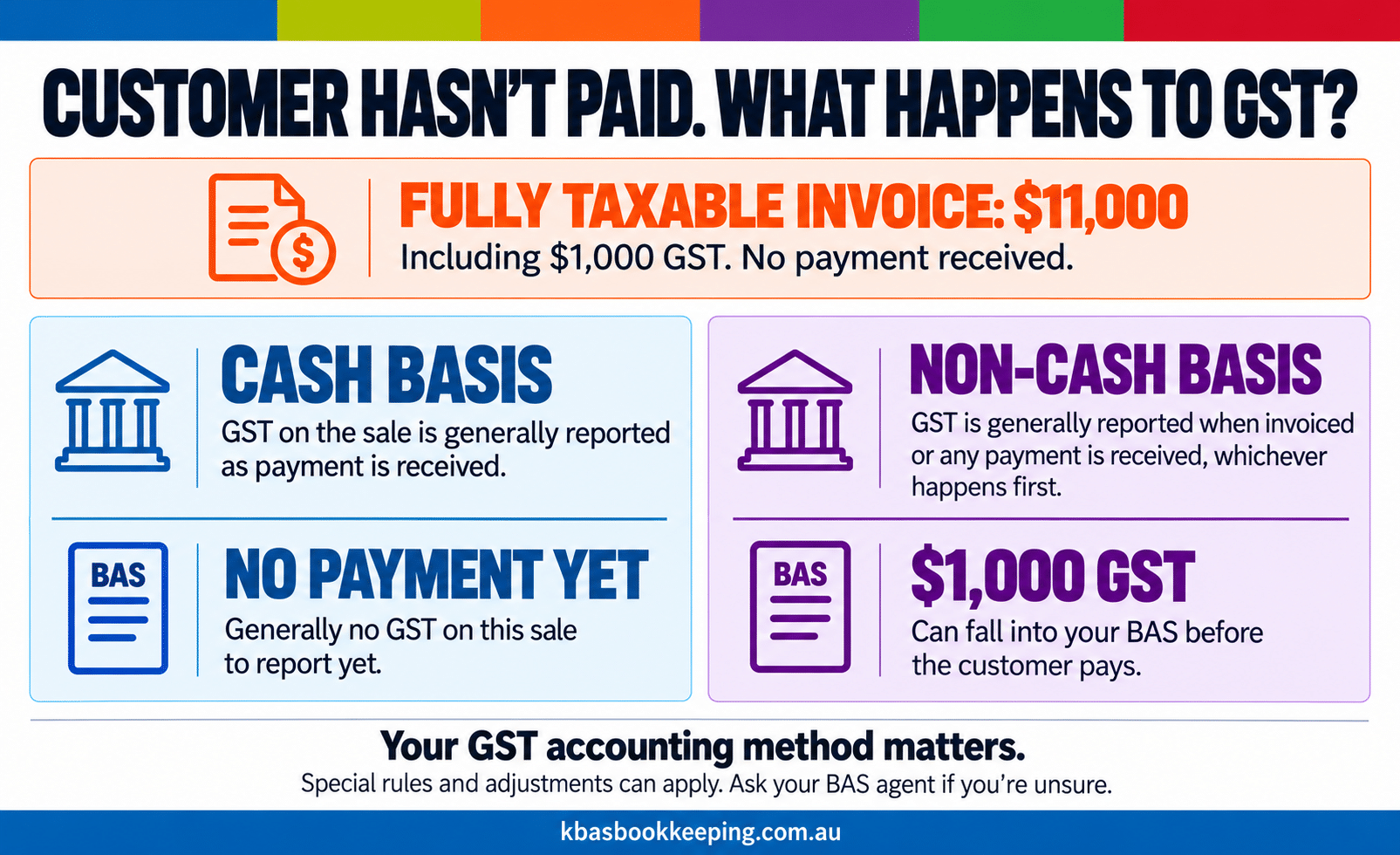
Your GST accounting method affects the BAS position:
- Cash basis: GST on sales is generally reported as customer payments are received, to the extent received.
- Non-cash basis: GST on sales is generally attributable when an invoice is issued or any payment is received, whichever happens first.
For example, a fully taxable $11,000 invoice includes $1,000 GST. On a non-cash basis, that GST can fall into a reporting period before the customer pays. On a cash basis, an entirely unpaid invoice generally doesn’t yet trigger GST on that sale. Special rules and adjustments can apply.
The ATO explains the accounting methods. Our guide to reading your BAS statement shows how the figures fit together. There is no universal DSO threshold that determines when GST becomes payable.
Get on Top of Accounts Receivable
Start with clear invoices and agreed payment terms, then make follow-up part of the working week. Keep the records reconciled so you know which customers genuinely need a reminder. Review older balances personally and use realistic collection dates when planning for BAS and other bills.
At KBAS, our bookkeeping and GST services help you keep reliable records and understand your obligations. As registered BAS agents, we can connect the bookkeeping with your BAS preparation and lodgement.
Talk to KBAS Bookkeeping about managing your accounts receivable as part of your ongoing bookkeeping, so you know who owes you what and when to follow up.
Frequently Asked Questions
Q: How Long Should I Give Customers to Pay an Invoice in Australia?
A: Choose terms you can afford and agree to them before the sale. Seven, 14 or 30 days may suit different arrangements, subject to applicable industry rules. Check a larger customer’s purchasing requirements before accepting work, and show the actual due date on the invoice.
Q: How Can I Follow Up Without Damaging the Relationship?
A: Start with a polite reminder stating the invoice number, amount and due date. Ask whether anything is preventing payment. If emails aren’t resolving it, call the person responsible and agree on a payment date. Keep records so the customer doesn’t receive conflicting messages.
Q: Can I Charge Late Payment Fees?
A: A late fee needs a valid contractual basis and must comply with applicable law. Don’t add one retrospectively because you’re frustrated. Have a solicitor review your proposed terms for enforceability, including penalty and unfair contract term risks. There is no universal safe percentage for every business.
Q: What Is a Healthy DSO?
A: DSO estimates collection time across your credit sales. Assess it against your terms, customer mix and previous performance. A sustained increase warrants investigation.
Q: When Should I Use a Debt Collector?
A: Consider one when repeated follow-up hasn’t resolved the debt and recovery is commercially worthwhile. Check the agency’s fees, recovery approach and any applicable licensing requirements, and get legal advice where the debt is disputed.
Q: Should I Require a Deposit Before Starting Work?
A: A deposit or progress payments can reduce exposure on project work, but the amount must suit the contract and industry rules. Queensland domestic building work has specific deposit limits. Check QBCC guidance before applying a general percentage to building contracts.
Q: Do I Need to Use e-Invoicing?
A: There is no general requirement for every Australian business to use Peppol e-Invoicing. It can be useful when your business customers support it.
Q: What Is the Difference Between Accounts Receivable and Accounts Payable?
A: Accounts receivable is money customers owe you. Accounts payable is money you owe suppliers. Reviewing both helps you see whether expected customer payments will cover upcoming bills and where you need to act before a shortfall develops.