

Table of Contents
- What is payroll compliance and why does it matter?
- Monthly payroll compliance tasks
- Quarterly payroll compliance tasks
- Annual and EOFY payroll compliance tasks
- Who this payroll compliance checklist is for
- How KBAS Bookkeeping helps with payroll compliance
- Local insights for Sunshine Coast employers
- The Bottom Line
- FAQs
Key takeaways
- Payroll compliance is a recurring system, not a single 30 June task.
- Monthly checks catch errors early — pay rates, leave, PAYG withholding, super and employee details.
- Quarterly checks keep you ready for BAS, PAYG withholding, super obligations and cash flow planning.
- Annual and EOFY checks prepare you for STP finalisation (due 14 July), wage changes and payroll system updates.
- Reviewing records throughout the year makes EOFY far less stressful.
Payroll compliance is much easier when it is not treated as a 30 June rescue job. For many business owners, payroll only becomes urgent when something is due, like STP finalisation, super, BAS, a new wage rate, a staff termination, or a question from an employee.
The better approach is to break payroll into a simple rhythm of what needs to be checked every month, every quarter and every year.
According to the ATO, for each financial year, employers need to finalise their STP data by 14 July. That makes right now the time to check that your payroll records, employee details, super, PAYG withholding, and reporting categories are accurate before finalisation is lodged.
At KBAS Bookkeeping, we work with business owners across the Sunshine Coast, from Caloundra and Birtinya to Maroochydore, Buderim, Noosa and all over QLD, who want payroll to be accurate, compliant and under control before deadlines become stressful.
What is payroll compliance and why does it matter?
Payroll compliance means paying your employees correctly, reporting payroll information correctly, keeping the right records, and meeting your employer obligations on time.
That includes wages, leave, superannuation, PAYG withholding, payslips, allowances, deductions, termination payments, employee records and Single Touch Payroll reporting.
The challenge is that payroll touches multiple areas of compliance. You may need to consider the ATO, Fair Work, modern awards, employment contracts, superannuation rules, state-based leave obligations, and your own bookkeeping system.
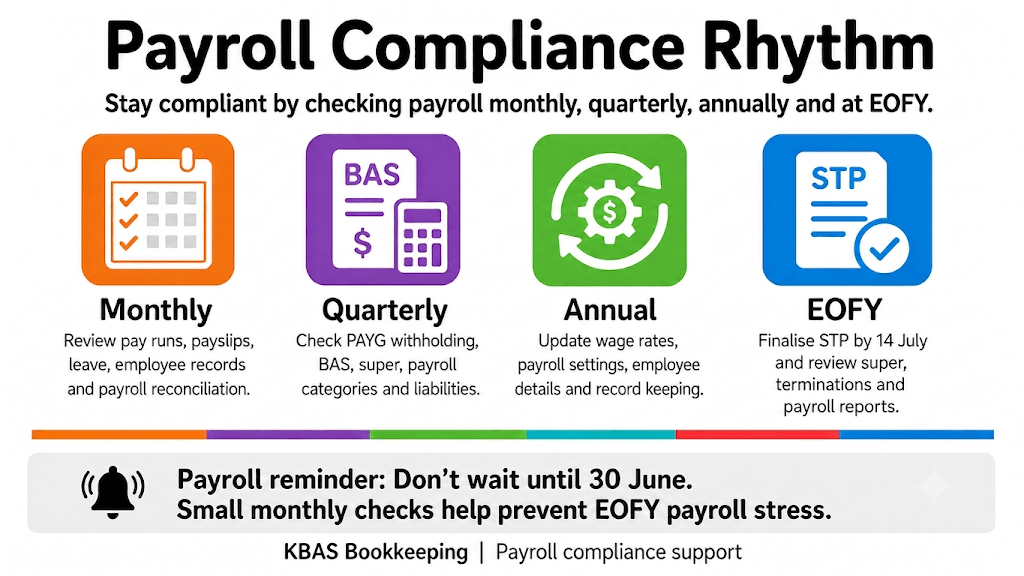
Monthly payroll compliance tasks
Monthly payroll tasks are where most payroll problems can be prevented. A small error in one pay run can become a bigger issue if it continues for months.
“Payroll should not be floating separately from the rest of your bookkeeping.”
1. Review each pay run before it is processed
Before wages are paid, check:
- Employee names and employment status
- Ordinary hours, overtime and penalty rates
- Allowances, reimbursements and deductions
- Leave taken and leave accrued
- Salary sacrifice arrangements
- New starters and terminated employees
- Superannuation settings
- PAYG withholding
This is especially important if your team works variable hours, has casual staff, changes rosters often or operates across hospitality, trades, construction, allied health, retail or professional services.
2. Issue payslips on time
A good monthly process is to check that payslips have been issued correctly and that the details match the pay run. This includes gross pay, net pay, tax withheld, superannuation and leave where relevant.
3. Reconcile payroll to your accounting system
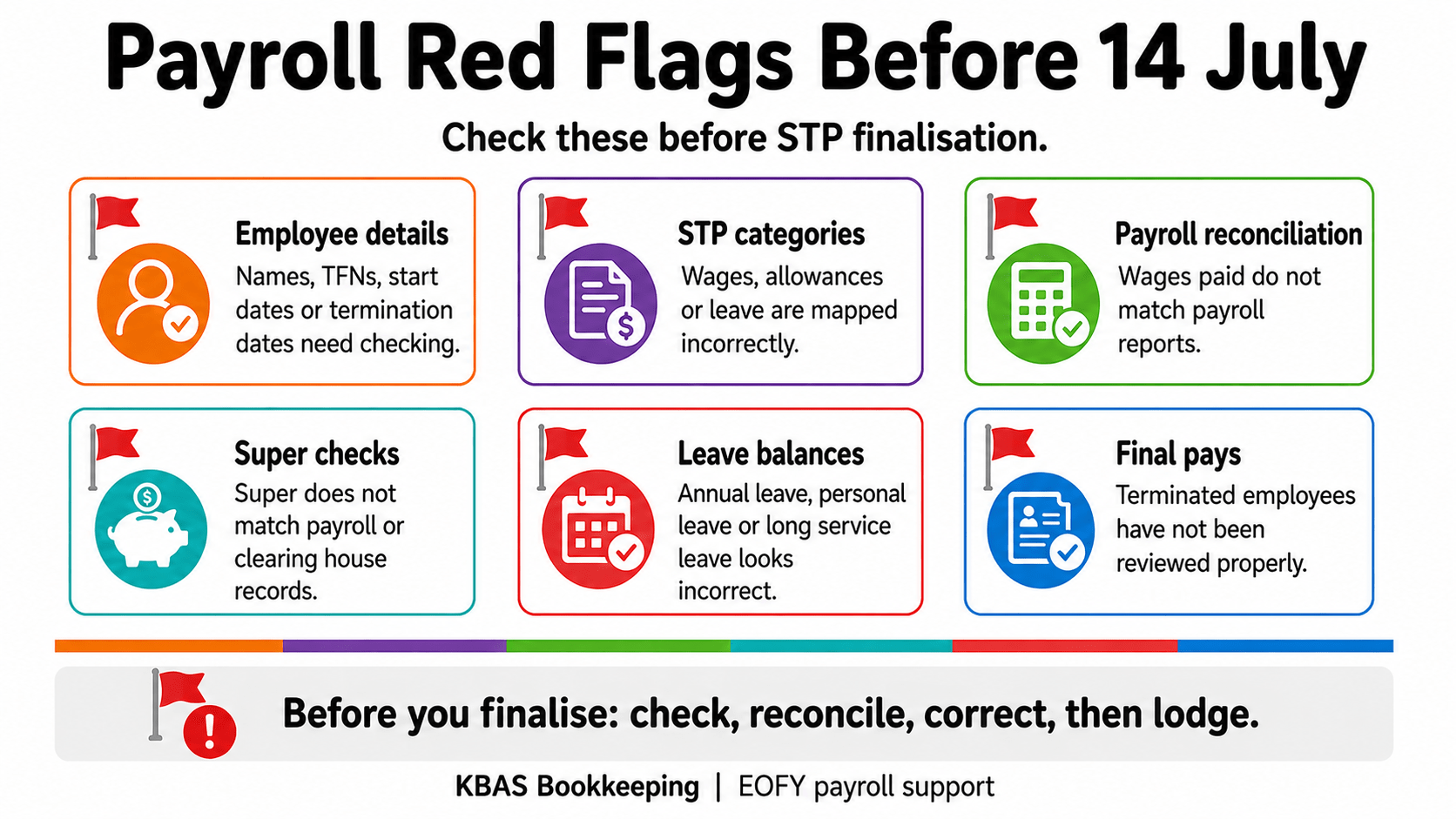
Payroll should not be floating separately from the rest of your bookkeeping. Each month, reconcile:
- Wages paid from the bank account
- PAYG withholding liability
- Superannuation payable payroll clearing accounts
- Leave liability reports
- Reimbursements and deductions
- Wages in your Profit and Loss report
This helps you see whether payroll costs are moving in line with the business. It also helps identify unusual changes before they affect cash flow.
For support with all of this, KBAS provides Bookkeeping, Payroll and GST services for Sunshine Coast businesses.
4. Check employee records
Keep employee details up to date, including:
- Tax file number declaration information
- Bank account details
- Super fund details
- Employment classification
- Award or agreement information
- Start dates and termination dates
- Leave balances
- Emergency contact details
The ATO outlines employer requirements for employment and payroll records, while Fair Work requires employers to keep time and wages records for seven years.
5. Review leave balances
Check annual leave, personal leave and long service leave regularly. For Queensland employers, long service leave should also be watched over time. KBAS has previously covered why long service leave needs to be tracked properly, especially when employees have been with the business for a long period.
This is not just a compliance issue. Leave liabilities affect your financial reports and cash flow.
Quarterly payroll compliance tasks
Quarterly payroll checks give you a chance to step back from individual pay runs and review the bigger picture.
“Payroll is not just data entry. It is a system that needs to reflect what is actually happening in the business.”
1. Check PAYG withholding and activity statement reporting
PAYG withholding reporting and payment depends on your withholding cycle and activity statement obligations. The ATO provides current BAS due dates for monthly and quarterly lodgements.
Each quarter, check that:
- PAYG withholding in payroll matches your accounting records
- Activity statement amounts are reasonable
- Wages and super reports reconcile
- Payroll liabilities have not been left sitting uncleared
- Any corrections are dealt with before lodgement
2. Review superannuation obligations
For the 2025-26 financial year, the super guarantee rate is 12%. Under the quarterly system, the ATO’s super payment due dates are generally 28 October, 28 January, 28 April and 28 July.
For the quarter ending 30 June 2026, the super payment deadline is 28 July 2026.
KBAS has already covered this in the Payroll and Super EOFY Checklist, so this article focuses on the wider payroll compliance rhythm.
3. Review payroll categories and STP reporting
Quarterly reviews are a good time to check whether payroll categories are mapped correctly for STP. Look at:
- Ordinary time earnings
- Overtime
- Paid leave
- Allowances
- Bonuses and commissions
- Directors’ fees
- Salary sacrifice termination payments
- Child support deductions, if relevant
STP Phase 2 requires more detailed payroll reporting, including separating certain payment types such as gross payments, allowances, paid leave, salary sacrifice and other reportable amounts. The ATO’s current STP Phase 2 employer reporting guidelines explain what needs to be reported through STP-enabled payroll software.
4. Check awards, classifications and employment arrangements
A quarterly payroll review should include a check of whether any staff roles have changed. Ask:
- Has a casual employee become regular and systematic?
- Has an employee moved into a higher duty role?
- Has a junior employee had a birthday that changes their rate?
- Has an apprentice or trainee progressed?
- Are allowances still correct?
- Are contractors being treated correctly?
This is where business owners often need support. Payroll is not just data entry. It is a system that needs to reflect what is actually happening in the business.
Annual and EOFY payroll compliance tasks
Annual payroll tasks are where everything comes together.
“STP finalisation tells the ATO that your payroll reporting for the financial year is complete.”
1. Finalise STP by 14 July
STP finalisation tells the ATO that your payroll reporting for the financial year is complete. For most employers, the STP finalisation declaration is due by 14 July each year.
Before lodging finalisation, review:
- Employee names and TFNs
- Gross wages
- PAYG withholding
- Allowances
- Deductions
- Salary sacrifice
- Superannuation
- Termination payments
- Leave payments
- Reportable fringe benefits, if applicable
- STP categories and payroll mapping
Once finalised, employees can access their income statement through myGov.
2. Check minimum wage and award changes
Each year, employers need to check whether wage rates have changed. Fair Work has confirmed that minimum wages increase from 1 July 2026, with new rates applying from the first full pay period starting on or after 1 July 2026.
3. Review payroll settings for the new financial year
At EOFY, check your payroll software settings before the first July pay run. Review:
- Tax tables
- Super guarantee rate
- Payday Super readiness
- Leave accrual settings
- Pay categories
- Award rates
- Deductions
- Allowances
- Employee classifications
- STP reporting categories
This is also a good time to clean up old payroll items that are no longer used. KBAS can assist with payroll software support and training if your system needs to be reviewed or tidied up.
4. Review terminated employees and final pays
Final pay rules can depend on the applicable award, agreement, employment contract and the National Employment Standards. Fair Work provides guidance on final pay, including when final pay is usually required.
At EOFY, review employees who left during the year and check that:
- Termination dates are correct
- Unused leave was paid correctly
- Employment termination payments were processed correctly
- STP reporting categories are correct
- Super was calculated where required
- Records have been retained
5. Keep payroll records properly
EOFY is the best time to check whether your records are complete. Fair Work requires employers to keep employee records for seven years, and those records must be accessible, legible and in English.
KBAS has also previously highlighted the importance of keeping proper evidence and records in What is acceptable evidence for claiming an expense.
Who this payroll compliance checklist is for
This checklist is useful for any Australian employer, but it is especially relevant if you:
- Employ casuals, part-time staff or full-time staff
- Have seasonal rosters
- Operate in hospitality, retail, trades, construction, health, professional services or tourism
- Use Xero, MYOB, QuickBooks or another payroll system
- Have staff across different roles or pay rates
- Are preparing for EOFY payroll finalisation
- Want fewer payroll surprises after 30 June
For Sunshine Coast businesses, payroll can be particularly active around seasonal peaks, tourism periods, school holidays and staffing changes.
“Different businesses have different payroll patterns, but the compliance rhythm is the same.”
A café in Caloundra, a clinic in Birtinya, a trade business in Maroochydore, a professional service firm in Buderim, or a tourism business in Noosa may all have different payroll patterns, but the compliance rhythm is the same.
How KBAS Bookkeeping helps with payroll compliance
Payroll compliance works best when your bookkeeping, payroll and reporting systems talk to each other.
KBAS Bookkeeping supports Sunshine Coast businesses with bookkeeping, payroll, GST, BAS and software support. The goal is not just to process transactions, but to give business owners clarity, confidence and better information to run their business.
“The goal is not just to process transactions, but to give business owners clarity and confidence.”
That may include:
- Setting up payroll systems correctly
- Reviewing payroll categories
- Checking STP reporting
- Reconciling wages and super
- Preparing BAS and PAYG withholding information
- Reviewing payroll before EOFY
- Supporting Xero payroll processes
- Helping owners understand what needs attention before deadlines
For business owners who want stronger numbers for decision-making, KBAS also provides Business Planning and Strategy support.
Local insights for Sunshine Coast employers
Payroll compliance is not only a national issue. It plays out locally in the way businesses actually operate. Across the Sunshine Coast, many businesses manage changing rosters, casual employees, weekend work, seasonal demand and tight cash flow.
Payroll errors can quickly become stressful when you are also trying to serve customers, manage staff and keep the business moving.
“A practical payroll checklist helps keep the pressure down.”
For businesses in Caloundra, Birtinya, Maroochydore, Buderim and Noosa, a practical payroll checklist helps keep the pressure down.
It gives you a clearer view of what is due, what needs checking and what should be fixed before EOFY. For a broader EOFY review, read KBAS’s guide to EOFY Bookkeeping Essentials.
The Bottom Line
Payroll compliance does not need to feel like a last-minute EOFY scramble.
When you break payroll into monthly, quarterly and annual tasks, you reduce the risk of mistakes, improve cash flow planning and give yourself more confidence before key deadlines like STP finalisation on 14 July.
“Payroll compliance does not need to feel like a last-minute EOFY scramble.”
If your payroll records need checking before EOFY finalisation, or you want a clearer system for the new financial year, KBAS Bookkeeping can help you get payroll under control.
FAQs
Q: What payroll tasks should I do every month?
A: Each month, review your pay runs, issue payslips, reconcile wages to your bank account, check PAYG withholding, review super calculations, update employee records and check leave balances.
Q: When is STP finalisation due for 2025–26?
A: For the 2025–26 financial year, employers need to finalise their STP data by 14 July.
Q: Do employers still need to give employees payment summaries?
A: For employees reported through STP, employees generally access their income statement through myGov once STP finalisation is complete. The key employer task is making sure STP data is accurate and finalised on time.
Q: When is super due after 30 June 2026?
A: For the quarter ending 30 June 2026, the quarterly super payment due date is 28 July 2026. Employers also need to prepare for Payday Super changes from 1 July 2026.
Q: How long do payroll records need to be kept?
A: Fair Work requires employers to keep time and wages records for seven years. The ATO also has requirements for employment and payroll records.
Q: When do payslips need to be provided?
A: Employers must provide payslips within one working day of payday.
Q: What should I check before the first July pay run?
A: Check tax tables, wage rates, super settings, leave accruals, allowances, deductions, employee classifications, payroll categories and STP reporting settings.
Q: Can KBAS help if my payroll is messy?
A: Yes. KBAS Bookkeeping helps Sunshine Coast businesses with payroll, bookkeeping, GST and BAS support, including businesses based in Birtinya, Caloundra, Maroochydore, Buderim and Noosa.